
How to Effectively Communicate Employee Engagement Survey Results
Jun 09, 2025
F
Flex Surveys 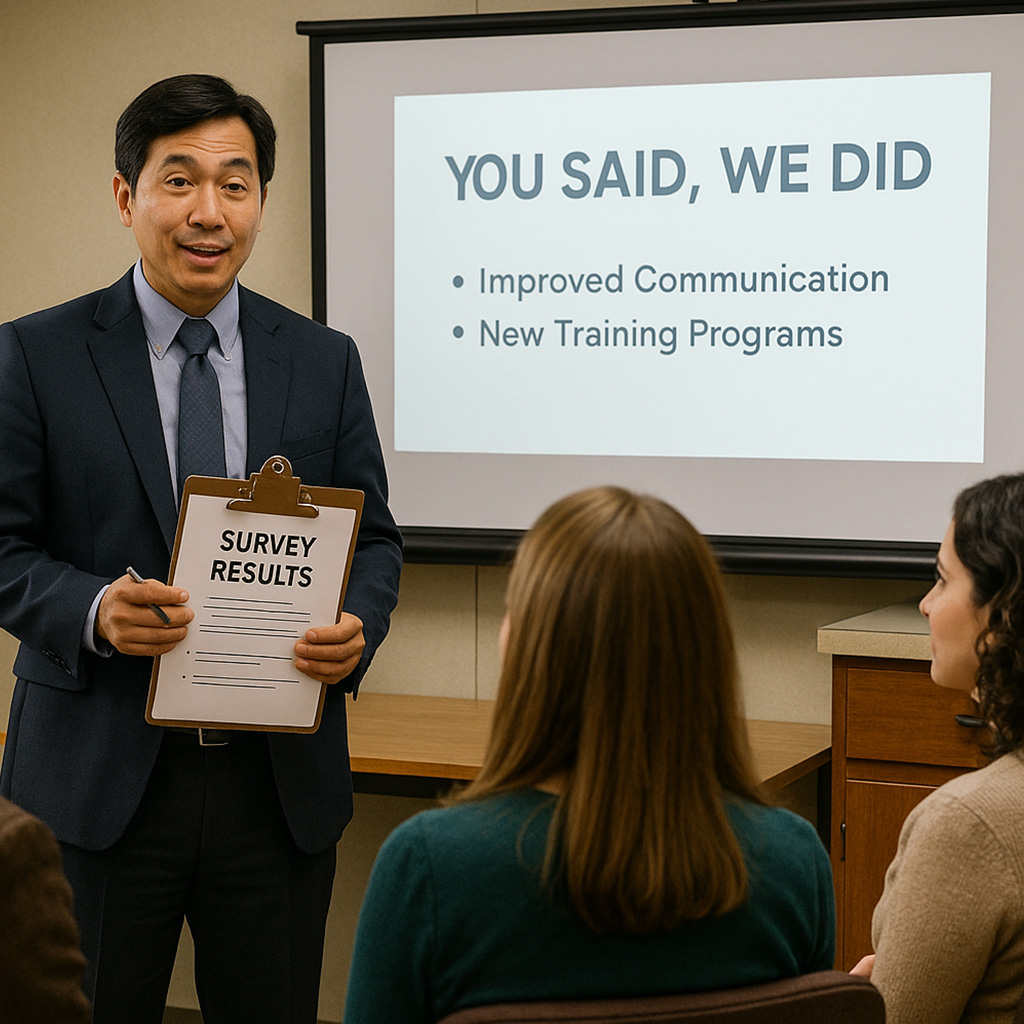
Employee engagement surveys can feel like just another HR task, but in reality, they hold the key to understanding what truly drives your workforce. When done well, they provide a window into employee sentiment—what’s working, what’s broken, and what’s quietly pushing people toward the job market.
Yet, too often, companies make the mistake of either treating these surveys as a formality or overloading employees with questions, only to let the results collect dust. A poorly executed survey isn’t just ineffective—it’s demoralizing. It signals to employees that their voices don’t actually matter because nothing changes.
But the biggest misstep? Failing to communicate the results effectively. Employees take time to share their honest thoughts, but when they’re met with silence or vague, corporate-speak summaries, engagement plummets. So how do you communicate survey results in a way that fosters trust and drives real action? Let’s break it down.
If employees took the time to complete the survey, they deserve to know what came out of it. Too often, leadership hesitates to share results, especially if they’re less than stellar. But hiding bad news doesn’t make it disappear—it just makes employees more skeptical.
Instead of sweeping negative feedback under the rug, acknowledge it head-on. A simple message like, “We heard you, and we know we have work to do,” goes a long way in building trust. Employees don’t expect perfection, but they do expect honesty. Research from the Edelman Trust Barometer shows that 63% of employees want their employers to be transparent about decision-making, especially when it affects workplace culture.
Dumping a 50-slide PowerPoint presentation into an email and calling it a day? Not effective. People absorb information differently, so consider multiple ways to share the results:
The key? Make it easy to understand, not overwhelming.
Numbers alone don’t tell a story. Saying, “Our engagement score dropped by 10%,” is one thing. But breaking it down—why it happened, what’s behind the numbers, and what leadership is doing about it—is where real communication happens.
For example, if survey results show a decline in trust toward leadership, don’t just report the stat. Provide context. Maybe a recent restructuring created uncertainty. Maybe employees feel left out of key decisions. Whatever the reason, spell it out in plain language.
Use real language, not corporate jargon. Instead of “We are taking a holistic approach to addressing engagement gaps,” try, “We noticed that employees want clearer career paths, so we’re rolling out a new mentorship program.”
Nothing breeds survey fatigue faster than employees feeling like their input goes into a black hole. If people take the time to share honest feedback, they need to see that it matters.
One of the best ways to do this? A “You Said, We Did” approach.
Even if some changes take time, showing progress—even small wins—reinforces that leadership is listening. And if something isn’t feasible? Be upfront about it. Employees will respect honesty far more than empty promises.
Communicating survey results isn’t a one-time event. It’s the start of an ongoing dialogue. After the initial results are shared, keep employees updated on progress. Check in periodically—quarterly pulse surveys, manager one-on-ones, or follow-up meetings—to ensure feedback loops stay open.
One company that does this well is Microsoft. They use real-time feedback loops, where managers have access to engagement data and are trained to address concerns in real time rather than waiting for an annual report. The result? Higher engagement and a culture of trust.
Because at the end of the day, employee engagement isn’t just about collecting data—it’s about building trust. And that starts with making sure people feel heard, valued, and included in the conversation. The more employees see their feedback in action, the more engaged they’ll be in the process. And that’s how real change happens.
Create your own employee engagement survey for almost anything.
A comprehensive suite of survey and insight solutions.